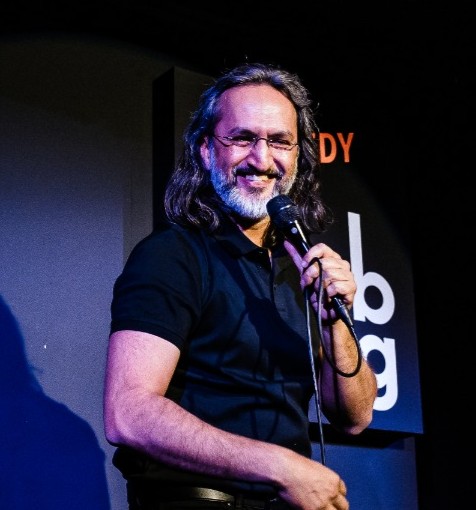
Papa CJ is an internationally acclaimed comedian, leadership coach, and educator who has spent more than two decades making people laugh, and, increasingly, making them think about why they behave the way they do.
He has performed across the world and worked with leaders and organisations across industries, moving comfortably between comedy stages, corporate boardrooms, and university classrooms. That unusual range is also what makes his perspective distinctive. Papa CJ understands audiences, leaders, workplaces, and human behaviour not just from theory, but from years of watching people respond, react, connect, resist, laugh, and occasionally squirm.
As an executive coach and educator, he brings the same curiosity to leadership that he brings to comedy: what makes people tick, what gets in the way of connection, and what happens when we stop taking ourselves quite so seriously?
His work today is increasingly focused on a question that sits at the heart of The Human Advantage: as artificial intelligence becomes capable of doing more of what humans have traditionally done, what should humans become better at?
For Papa CJ, the answer is not simply to compete with machines. It is to understand what makes us human in the first place and to deliberately strengthen those qualities; curiosity, empathy, judgement, creativity, courage, connection, the ability to read a room, the ability to change someone’s mind and the ability to make another person feel seen.
As an educator, he is bringing these ideas into the classroom, working with the next generation of professionals and leaders. His approach is deliberately unconventional: serious ideas do not always require serious faces, and some of the most useful conversations begin with a laugh.
Whether he is performing on stage, challenging a leader in a coaching conversation, or teaching a room full of students, Papa CJ brings an uncommon combination of wit, candour, insight, and humanity.
At a time when technology is rapidly redefining what we can do, his work asks a more interesting question: how do we become more intentionally human?